
Trace Former Jewell County Property Owners
Former owners come from transfers read backward, never from a modern owner list. Start with the newest deed for the same legal description in Jewell County property records. Record its grantor. Then locate the deed by which that grantor first took the land. Repeat the climb. Jewell County publishes no online date range for its deed books. Treat any earliest-year or cutoff figure with caution.
| Source | Years It Covers | Where Held | What It Shows |
|---|---|---|---|
| Recorded deed chain | Coverage cutoff unverified | Jewell County Register of Deeds | Grantor, grantee, instrument, date, legal description |
| Paper deed books or microfilm | Exact run unverified | Ask Register, KSHS, and library | Transfers before any electronic index |
| Owner atlases and plat books | 1884, 1908, 1921, circa 1957 | KSHS and Kansas Memory | Named owners, town plats, land context |
| Newspaper microfilm | Confirm title and date runs | Mankato City Library or KSHS | Probate, sheriff-sale, tax-sale, and transfer leads |
Deeds are the backbone of any owner-of-record chain. Atlases and newspapers supply names and date clues. Use them when the deed index is offline or a place name has changed. Still, they cannot replace a recorded transfer.
Begin with a legal description stable enough to follow through time. A town parcel may rely on lot, block, and addition language. Rural land usually turns on section-township-range or metes and bounds. Street addresses, postal cities, and even parcel numbers can shift over the years. Keep every historical identifier in your notes. But require the land description itself to match before adding a name to the chain.
The deed type matters too. Warranty, quitclaim, trustee, administrator, executor, correction, and transfer-on-death instruments may all appear in one sequence. Their labels describe the instrument, not the quality of the title. Read the full recorded document and note exceptions, reservations, and references to earlier instruments.
Build a Jewell Deed Chain Backward
Keep one row per transfer so names and legal descriptions never drift apart. Never fill a missing link with an atlas guess.
| Transfer date | Grantor to grantee | Deed type | Book, page, or instrument |
|---|---|---|---|
| Newest verified date | Prior owner to current grantee | Copy from index | Copy exact reference |
| Next earlier date | Earlier owner to that prior owner | Copy from index | Copy exact reference |
| Unresolved link | Search estate, probate, or court record | Do not guess | Record request pending |
A probate order can snap a simple sequence. So can a trustee's deed, correction deed, or name variation. Match the land, not just the surname.
Record both the execution date and the recording date whenever the instrument supplies them. They often differ. The recording date is what orders the public chain in the deed records. Copy the grantee's vesting language and every book-page or instrument cross-reference exactly. A later correction deed may fix a name or description without signaling a new open-market sale.
When a link is missing, search around the date. Don't force the next surname into place. Look for probate. Look for a transfer-on-death affidavit, sheriff or tax sale, quiet-title order, trustee conveyance, or an entity-name change. Then confirm the resulting instrument was actually recorded against the same land in Jewell County.
Go Back Through Jewell County Grantors
Phone the Jewell County Register of Deeds at 785-378-4070, or write to jwdeeds1@jewellcountyks.gov. Provide the address, the parcel number if you have it, and the full legal description, then ask which indexes and book access channels the office can open for you.
- Find the newest deed with today's owner as grantee and verify its legal description.
- Read the grantor on that deed. This is the next former owner to research.
- Search that grantor as a grantee in an earlier transfer, then repeat while the legal description still matches.
- At the electronic cutoff, ask for the reverse index, deed book, microfilm, copy rules, and exact earliest coverage.
- Grantor
- The party conveying the recorded interest.
- Grantee
- The party receiving the recorded interest.
- Chain of title
- The linked sequence of transfers affecting the same land.
- Reverse index
- An index organized to help locate a party on the opposite side of a transfer.
- Quitclaim and warranty deed
- Different instruments whose labels do not alone prove the quality of title.
The county's official page names the Register and lists contact details. It offers no search form, no document images, and no posted fee schedule. So ask directly. Staff may be able to search by grantor, grantee, instrument type, or recording-date range. Book and page references and legal descriptions can work too. Find out whether the books you need sit at the counter. They may instead live on microfilm or exist as scanned images.
A narrow request keeps the work, and any staff cost, to a minimum. Hand over your last verified deed reference. State the goal plainly: the immediately prior acquiring deed and its grantor. If the job calls for a wide date range or a bulk index pull, request an estimate under K.S.A. 45-219 before copies are run.
Use Jewell's 1884 and 1921 Owner Atlases
The Kansas Historical Society ownership-map guide lists Jewell County plat holdings from 1884, 1908, 1921, and about 1957.
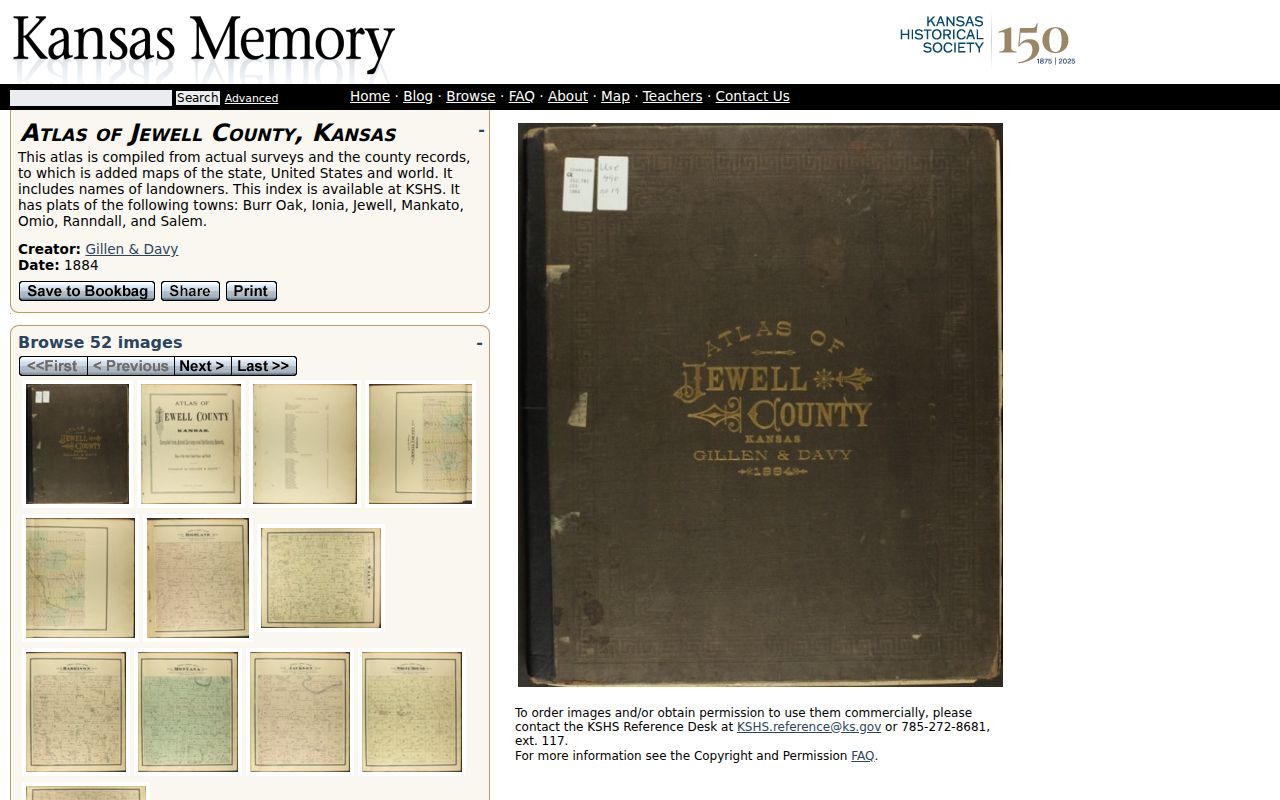
Copy the atlas owner's name exactly, along with the section-township-range or lot-block clue. Then take that name into the deed records. An atlas label is historical evidence only, not a current statement of title.
The 1884 atlas earns special attention. Kansas Memory describes it as compiled from surveys and county records. Landowners and town plats are included. Set it beside the 1908, 1921, and circa-1957 volumes to narrow when a name changed. That interval becomes your deed-index search range.
Match Atlas Names to Jewell Deeds
Atlas spellings and deed index spellings often disagree. Try surname variants, initials, and phonetic forms before giving up on a match. A candidate may appear under several spellings. Confirm the parcel by section, township, range, lot, block, or plat rather than trusting the map's label. An atlas can also blur details that the recorded instrument keeps precise. These include an estate division, a joint tenancy, or an entity holding title.
Search Jewell City, Jewell Centre, and Mankato
Jewell County was organized in 1870, and its county seat did not stay put. Voters moved it from Jewell City to Jewell Centre, today's Mankato, after elections in 1873 and 1875. So one parcel can appear under any of three names in early deed records, court files, and newspaper notices. That mismatch often looks like a missing land record. Usually the record survives under a different place name.
No courthouse fire or reindexing loss explains a gap here. Don't invent a disaster as a shortcut. Instead, ask the recorder for the historical index, the book, the microfilm reel, and any finding aid that covers the era you need.
City-level clues can sharpen a property search. Jewell's town site was filed in 1870. Mankato's minutes preserve an Original Town lot-and-block example, while Burr Oak's 1871 layout and railroad history point toward plats and right-of-way instruments. Apply each clue only to the land it describes. Then step back into the county deed chain, where the owner of record is established.
Follow Jewell Former Owners Into Newspaper Microfilm
The Mankato City Library at 214 N High Street is a strong fallback. Staff there can confirm exact newspaper titles and date runs on microfilm. The library also holds the five-volume Jewell County Cemeteries set. The local genealogy source identified the set. Probate notices, sheriff sales, and tax-sale notices fill those papers. Obituaries appear there too. Each can explain a break in the deed chain. Cite the paper, date, and page. Then return to the recorded deed or court order for proof.
The Kansas Historical Society newspaper database searches by city, publication, title word, and county. You can also narrow by date range. Try a former owner's surname paired with estate, sheriff sale, administrator, executor, or property-description terms. A single notice can surface a case number or sale date. That detail often leads straight to the District Court file. It may also point to a recorded deed in the property records.
Vital records carry separate limits. Kansas certificates are restricted under K.S.A. 65-2422d except for eligible requesters and specified historical material. A death record may support estate research. Still, it cannot transfer land or name an heir without probate and deed evidence.
Confirm Jewell Ownership Record Depth
The honest answer avoids guessing a year. No official Jewell deed-index link, earliest online year, or microfilm list is published here. Ask the Register of Deeds for the exact cutoff. Also ask about access to older deed books. Then check with KSHS or the library about preserved copies or finding aids.
Coverage gap. Jewell's earliest online index year remains unverified. Older former owners may require deed books, microfilm, atlases, probate files, and newspapers.
Use this work for house history, estate research, and lawful property diligence. For one deed's mechanics, continue to the Jewell County deed records guide. Need a copy? The same guide covers that. Keep unresolved gaps visible in the chain table. Note each repository searched, index spelling, date range, and staff response. A blank online result does not mean no earlier owner of record existed. Jewell County has not published its electronic cutoff or the location of every older deed book. Even so, the tax roll and plat may still hold answers.