
Read Jewell County Deed Records by Type
An instrument's title signals the transaction. It rarely settles every title question on its own. Ask the Register to pull the exact deed type, then read the full recorded instrument, including the parties, execution and recording dates, legal description, reservations, exceptions, and references to earlier documents.
| Deed Type | What It Does | Common Use |
|---|---|---|
| Warranty deed | Conveys the stated interest with covenants | Conventional transfer |
| Quitclaim deed | Conveys whatever interest the grantor holds | Interest cleanup or related-party transfer |
| Special warranty deed | Uses narrower warranties | Limited-covenant conveyance |
| Trustee, executor, or administrator deed | Conveys through a fiduciary capacity | Trust or estate transfer |
| Correction deed | Corrects a prior instrument | Name or description correction |
Mortgages, releases, assignments, easements, mineral instruments, liens, lis pendens, and memoranda of lease sit beside deeds in the records. They affect or give notice of an interest without necessarily transferring fee ownership.
The Jewell Register Is the Verified Route
Jewell County's official Register page places the office at 307 N Commercial Street, Suite 7. It sits in Mankato. Amanda Davis serves as Register, with Briana Davis's colleague Briana Kohn as deputy. Reach the office at 785-378-4070 or jwdeeds1@jewellcountyks.gov. The Kansas Register of Deeds Association listing posts hours of 8:30–4:30, so call before traveling. The county offers no online search form, image viewer, or fee schedule. Ask in person whether staff can search by grantor or grantee. Staff can also search by instrument type, date range, legal description, book and page, instrument number, or parcel cross-reference. The Register's office page displays the current contact details.
The Jewell County Register of Deeds can confirm record availability directly, though the county offers no online deed image search.
Supply the Clerk With Searchable Clues
| Request field | Why it narrows Jewell deeds |
|---|---|
| Grantor and grantee | Locates transfers under both party roles |
| Instrument type | Separates deeds from releases, liens, or easements |
| Recording date range | Limits same-name results |
| Legal description | Matches the same land despite an address change |
| Book/page or instrument number | Points to one recorded item |
| Parcel cross-reference | May connect assessment and recording systems if maintained |
Request the index entry first. Then ask for the complete image or a certified copy. A deed's street address may be missing or outdated, so lot and block, the addition, metes-and-bounds, or section-township-range is the stronger key for a parcel search.
Walk Jewell County's Grantor-Grantee Trail
The office must confirm whether its index runs by grantor and grantee. It can also say how names are normalized. Once the newest recorded deed is identified, the basic backward method still works well.
- Find the newest deed with the apparent current owner as grantee.
- Read the grantor and exact legal description from that instrument.
- Search that grantor as the grantee on an earlier acquisition deed.
- Repeat, resolving corrections, estates, trusts, and changed entity names.
- Move to deed books or other finding aids where electronic coverage ends.
- Grantor
- The party conveying the stated interest.
- Grantee
- The party receiving it.
- Chain of title
- The ordered succession of recorded interests in the same land.
- Book/page or instrument number
- Alternative identifiers whose local use must be confirmed with the Register.
Older Owners Live Beyond the Web
The earliest year in Jewell County's electronic index remains unpublished. The Kansas Historical Society finding aid lists Jewell County atlases and plat books. Dates include 1884, 1908, 1921, and about 1957. These sources can surface an owner name, town plat, or section location to carry into the deed books. Take those details into the deed books. They are historical clues, not present title evidence. The 1884 Jewell atlas is viewable in this Kansas Memory source.
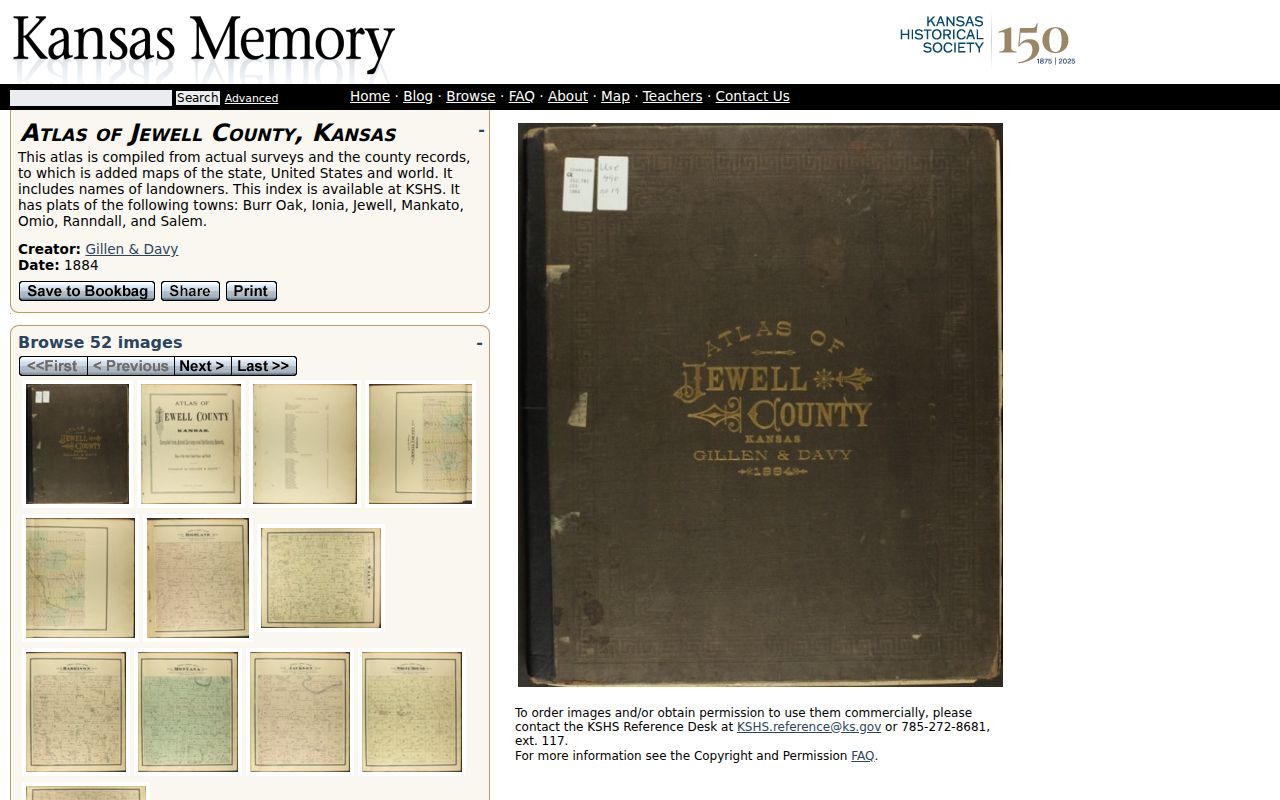
Transcribe the name and land description, then reconcile both against the Register's instrument.
County-Seat Names Can Hide Early Deeds
County-seat elections moved the center of government among Jewell City, Jewell Centre, and Mankato. This went on from 1870 through 1875. Search all three place names. Old indexes, court notices, newspapers, and atlas descriptions may use any of them. A mismatch can reflect shifting civic geography rather than a missing deed. No courthouse fire, record-loss event, or reindexing episode appears in the county's documented history. So resist inventing an explanation for a gap. Ask the Register for the historical finding aid. Also ask for the location of original books, microfilm, or transferred material.
Monitor Deed Fraud Without Inventing an Alert
Jewell County offers no confirmed property-fraud notification signup. State legislative testimony in 2026 did discuss forged deeds. A neighboring county's program does not establish a local service. Ask the Register whether notification is now available, check index activity periodically, and obtain any questionable instrument promptly for professional review. Kansas transfer-record statutes connect recorded transfers to appraisal administration. Yet they promise no instant public roll update, so a newly recorded deed can precede the Appraiser's ownership display.
Match Every Deed to the Same Land
A clean chain needs more than repeated surnames. Compare the legal description on every Jewell County deed. Check the acreage, lot and block, addition, section-township-range, reservations, exceptions, and cross-references too. A correction deed may repair a name or description. A replat, vacation, split, combination, or right-of-way conveyance can change the unit being followed. When the description changes, locate the recorded plat or related instrument before continuing backward.
Mankato's documented permit at 112 S Clinton shows the crosswalk. The council minute identifies Lots 5 and 6, Block 44, Original Town. That wording can guide a Register and plat-book search. The street address alone may not appear in an old deed. For rural land, section-township-range serves the same function. Metes-and-bounds descriptions demand careful comparison and sometimes professional surveying help.
Never infer a boundary from ORKA, aerial imagery, a fence, road, railroad, or tax acreage. A roadway edge may be a public right-of-way. A railroad strip may be an easement, an abandoned corridor, or a separate parcel. The deed, plat, easement, vacation document, and survey evidence each answer a different part of the boundary question.
Resolve Mortgages, Releases, and Court Notices
A deed chain can look finished on paper. But mortgages, liens, and easements may still attach to the parcel. Ask the Register to run the encumbrance side of the index. That search covers mortgage assignments and releases, materialmen's liens, federal tax liens and their releases, easements, memoranda of lease, mineral instruments, powers of attorney, and terminations. Match each entry to the legal description. Then chase every referenced book, page, or instrument number until the thread runs out.
A lis pendens announces litigation. It is not a judgment. To see the underlying case, search Kansas CaseSearch by party or case number. Or ask the Jewell District Court Clerk at 785-378-4030 for the public docket, pleadings, orders, and judgment. Foreclosure, quiet title, probate, partition, condemnation, and boundary disputes can all explain a deed's shape. So reconcile any court hit against the recorded conveyance rather than trusting one alone.
Older instruments may sit at the courthouse terminal or in the clerk's file. Protected matters stay closed to the public. Federal bankruptcy and lien litigation live in separate systems. The U.S. District Court for Kansas and PACER use their own case identifiers. Keep those numbers distinct from county instrument numbers to avoid confusion later.
Request a Jewell County Deed Copy
The Register takes requests by phone, email, mail, and at the Mankato counter. Say whether you want an ordinary or certified copy. Ask for the current price and the accepted payment method. Ask whether delivery is electronic or paper. The Register publishes no fee schedule. Confirm the cost directly and rely only on the office's own figure.
If the office insists on a written request, the Kansas Open Records Act framework applies. Wait, that link belongs below. The correct framework is the Kansas Open Records Act. Identify the existing record precisely and request an estimate. Let the custodian explain any delay, denial, or referral to the responsible office. KORA allows actual costs. It does not require the custodian to build a new title report for you.
Recorded, not guaranteed. Jewell County deed records show what was accepted and indexed; they do not resolve every unrecorded interest, boundary conflict, or court order and are not a title opinion.
Bridge Atlas Owners Into the Deed Chain
The 1884 Jewell atlas was built from surveys and county records. It names owners and shows town plats. Later editions followed in 1908, 1921, and around 1957. Start with a legible owner and a mapped location. Then search that person as grantee and grantor across the relevant period.
Transcribe the land details carefully. For farms, that means section, township, range, acreage, roads, and adjoining owners. For town lots, keep the town, addition, block, lot, alley, and railroad clues. Compare everything against the recorded deed and plat. An ownership map will not show mineral interests, easements, mortgages, life estates, or trusts.
Place names shift too. Jewell City served as an early county seat. Jewell Centre came before Mankato, and the name change played out between 1870 and 1875. Search each variant in deed books, court indexes, newspapers, and finding aids. An old filing under a former name does not mean the land left Jewell County.
When an atlas owner vanishes from the record, a newspaper probate or sale notice may supply a date and a fiduciary. Pull the related court file and Register instrument. Do not infer an heir from a surname alone. Cemetery and vital sources can clarify identity within access rules, but they convey no title.
Check Execution and Recording Details
Inspect every requested instrument closely. Check the grantor and grantee names, signatures, acknowledgment, preparer information, grantee mailing address, title, complete legal description, execution date, recording date, and references to earlier documents. Kansas law requires signed, acknowledged, legible records on accepted paper sizes. Confirm current county practice with the Register.
Execution and recording dates often differ. Recording carries the notice consequences under Kansas law. Never reorder transfers using only the signature date. Ask the clerk how corrections, re-recordings, marginal references, and releases appear in the local index, then follow every cited instrument to its source.