
Start a Jewell County Property Records Search
A search that holds up starts with parcel identity. In Jewell County that means the Appraiser and the ORKA map before anything else. Once the parcel number is settled, the Register of Deeds supplies the recorded deed. That deed confirms the transfer trail. The Treasurer comes next for the tax bill and payment status. District Court adds foreclosure, quiet-title, probate, lien, partition, and boundary case files. City Hall records round things out with permits, zoning, utilities, and council actions. They never replace the county's deed records.
Take notes as you go. Record the date you pulled each item. Copy every name, parcel reference, legal description, year, and instrument number exactly. Keep the limits in mind too. A map line is not a survey. The assessment roll may lag behind a recorded deed, and a tax bill reflects the tax roll rather than market value. A docket entry, likewise, is not a final title answer.
- Normalize address, city, ZIP, directional, suffix, and historic name.
- Ask the Appraiser for parcel, owner, situs, mailing, class, legal description, and value.
- Confirm the newest transfer and prior chain with the Register.
- Obtain the bill, receipt, or delinquency file from the Treasurer.
- Compare ORKA and plats, then request certified records where reliance matters.
The Mankato Offices Behind Jewell County Records
Nearly all county functions sit in one place, the courthouse in Mankato. That holds true whether the parcel lies in Jewell, Burr Oak, another town, or a rural township. Call ahead before visiting. The published county directory leaves out complete courthouse hours. A quick phone check prevents a wasted trip.
Jewell County Register of Deeds
307 N Commercial Street, Suite 7
Mankato, KS 66956
785-378-4070
The Register Has No Confirmed Public Index
The county's official Register page lists office contact details but offers no deed search form. The Register publishes no online deed index. It offers no image viewer, fee schedule, or result limit either. Requested records come by phone or by email to jwdeeds1@jewellcountyks.gov. Include the grantor, grantee, instrument type, date range, and legal description. Add any book and page or instrument number you already hold. The county's Register page shows the contact route that is currently available.
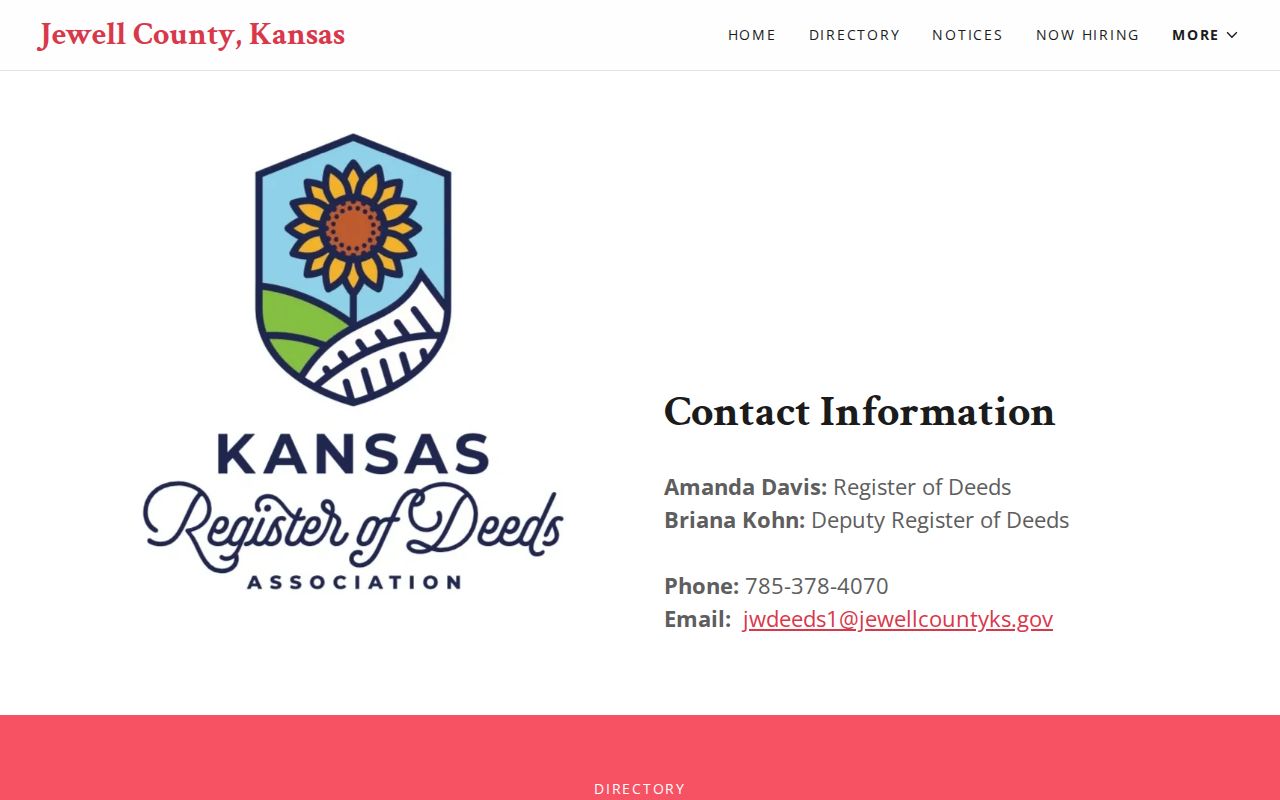
No public query interface exists for the register's index. Use phone, email, the counter, mail, or a KORA request instead of relying on an unverified third-party index.
ORKA Map Context Has Limits
ORKA is the practical statewide route for Kansas appraisal data and parcel mapping. Public access and available layers vary from county to county, though. Jewell County's own parcel participation is not guaranteed. The geocoder accepts an address or place, extra address lines, neighborhood, city, county, state, and ZIP. The ORKA extras service adds partial address and parcel annotation. Lots and blocks, roads, railroads, schools, and zoning layers are included too. Treat the map as a candidate finder, then compare the recorded legal description and plat. The ORKA status experience displays the current statewide picture.
A statewide map interface alone never proves a specific Jewell County parcel or layer is public.
Assessed Value Follows Kansas Classification
Parcel valuation and classification questions belong to the Appraiser. KDOR guidance sets the assessment ratios: 11.5 percent for residential property, 25 percent for commercial and industrial, 12 percent for vacant lots, and 30 percent of use value for agricultural land. Assessed value is the taxable base. Local mill levies are applied on top of it.
The Jewell County value and tax summary reports county-wide totals rather than a parcel card. For a single address, ask the Appraiser for the classification, land and improvement components, appraised and assessed amounts, exemptions, and valuation history.
Which Jewell County Record Answers the Question
No single database tells the whole property story in Jewell County. Match each question to its legal custodian, then tie the records together with the parcel number and legal description.
| Record Type | What It Documents | Kept By | Access |
|---|---|---|---|
| Deeds and releases | Transfers and recorded interests | Register | Office request; public web index unconfirmed |
| Assessment | Owner roll, class, parcel, value | Appraiser | Office; ORKA participation unconfirmed |
| Tax | Bill, receipt, delinquency | Treasurer | State payment route plus office request |
| Plat and map | Legal layout and geographic context | Register / ORKA / KSHS | Recorded plat and map aids |
| Permit and zoning | Municipal work and land-use actions | Relevant city | Clerk request; no city portal confirmed |
Turn to Jewell County deed records for the chain of title and instruments. Use property tax records for assessment rolls and tax bills, and parcel maps for map layers and plat cautions.
City Records Form a Separate Layer
Mankato, Jewell, and Burr Oak run no title offices of their own. Their city clerks can still hold real gems. You may find permits, zoning, ordinances, council minutes, utility connections, street actions, special assessments, annexations, and plat-vacation material. One Mankato example shows how this works. The 2019 council minutes identify 112 S Clinton as Lots 5 and 6, Block 44, Original Town. That description translates directly into a county deed and plat search. None of the three cities offers a searchable permit portal. Use Mankato records, Jewell records, or Burr Oak records for this city layer. Then return to the county for title, value, and tax.
Courts Can Explain a Title Dispute
The Jewell District Court Clerk, 785-378-4030, is the local source for public foreclosure, quiet-title, probate, partition, condemnation, and lien files. Easement and boundary disputes are filed there too. Kansas CaseSearch supports search type and term, case type, date-of-birth, filing-date range, and advanced controls. Visibility still depends on law and access.
Search by party or entity name to find a case number. Then ask the clerk for the register of actions and public pleadings. Orders, judgment, and certified copies are available too. Older documents may remain at the courthouse terminal. Sealed, juvenile, adoption, grand-jury, and other protected material is not part of open property research.
Atlas and Newspaper Sources Reach Older Owners
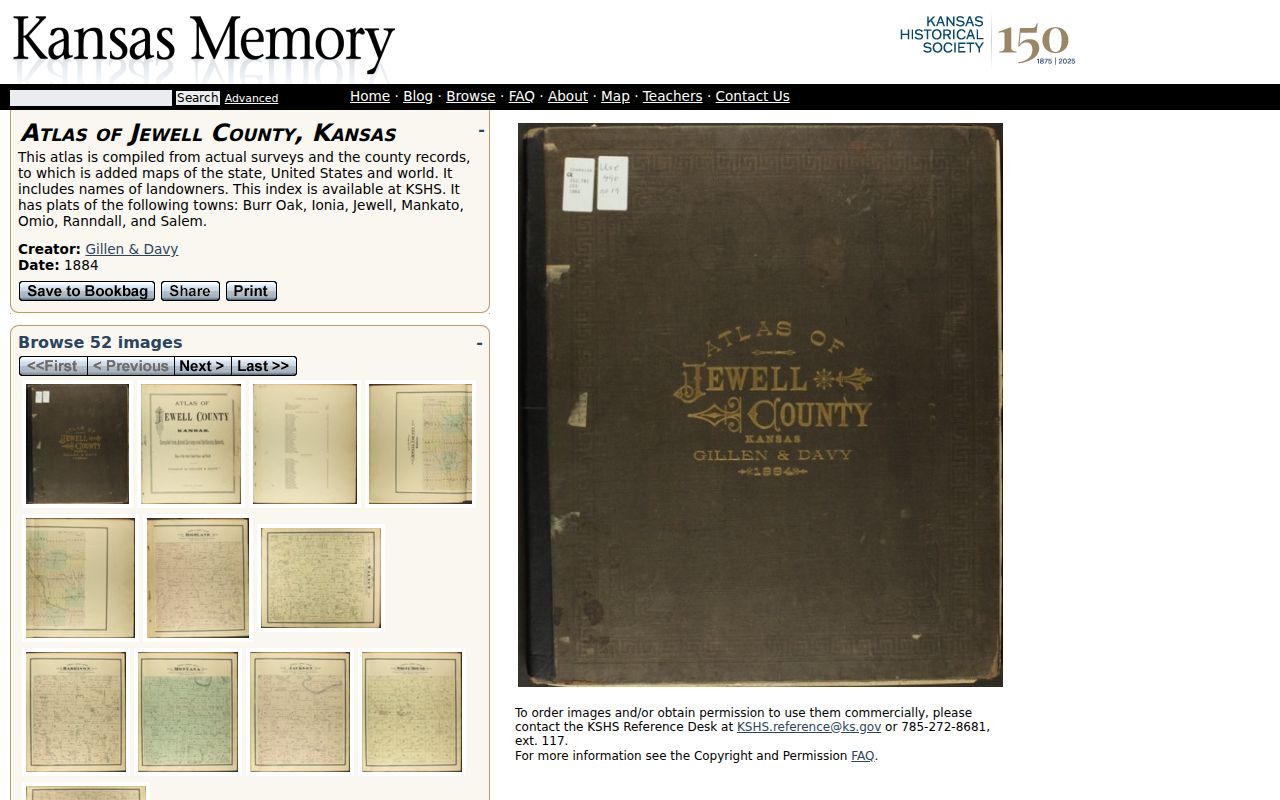
Historical owners are reachable through old atlases. The Kansas Historical Society catalogs Jewell County atlases and plat books. Coverage spans 1884, 1908, 1921, and roughly 1957. The 1884 volume draws on surveys and county records and names owners alongside town plats. Transcribe the owner and land description, then verify later transfers in the deed books. The 1884 atlas source preserves this historical path online.
Mankato City Library and KSHS newspaper microfilm add probate, sheriff-sale, tax-sale, and property notice leads. Every such lead still needs an instrument or court record to confirm it.
KORA Is the Offline Search Tool
K.S.A. 45-218 opens public records to inspection during regular office hours, and the custodian must act promptly, normally by the end of the third business day. Copying is not always free. Under K.S.A. 45-219, an office may charge its actual copying and staff costs, require a written request, or ask for advance payment. Say exactly what you need. Name the custodian and the existing record, along with the property address, legal description, parcel, owner or entity, date range, and format. Ask for an estimate too. No office has to build a new report on request. Separate requests to the Appraiser, Register, Treasurer, court, or a city keep custody clear.
Use Legal Descriptions Across Jewell County Systems
A street address is only a starting clue. Land carries a more durable identity. A recorded instrument may describe a town parcel by lot, block, and addition, while rural acreage runs by section, township, and range, and some documents use metes and bounds. Copy the description exactly, addition and town name included, and compare it across the parcel card, the deed, and the recorded plat. Never treat two similar descriptions as identical.
An address search can fail for small reasons. The state iKan tips suggest dropping the directional or suffix and trying again. The Appraiser can then supply the situs-to-parcel crosswalk. Mankato's documented permit at 112 S Clinton ties that modern address to Lots 5 and 6, Block 44, Original Town. The example shows how a city council record can hand you the lot-and-block language the Register needs. It proves neither ownership nor what stands today.
Rural Jewell County needs careful labels. Keep postal city, township, county, ZIP, and situs separate. A 66956, 66949, or 66956 mailing clue is not an incorporated boundary. Near a city edge, request the annexation ordinance and its adopted map. Near a road or former railroad, ask what the visible strip actually is. It may be right-of-way or an easement. It could also be city-owned land or a separately assessed tract.
Recorded Instruments Extend Beyond Deeds
A deed search can pull far more than deeds. The Register's indexes cover warranty, special-warranty, quitclaim, correction, mineral, trustee, executor, administrator, and transfer-on-death deeds. They also cover mortgages, assignments, releases, easements, terminations, powers of attorney, contracts for deed, and affidavits. Certificates of trust, memoranda of lease, federal tax liens, materials or services liens, lis pendens, and related UCC filings round out the list. Request each instrument type by name. Then read the full image, because an index label is only a finding aid.
Recording rules live in K.S.A. 58-2221 through 58-2224. Those Kansas provisions govern instruments affecting real estate and set the notice consequences of recording. An index result is not a title opinion. Electronic-recording authority permits digital receipt and conversion. It does not prove Jewell's older books are imaged or public online.
The county publishes no online fee schedule, earliest electronic year, property-fraud alert, or record-loss notice. Ask the office directly. Confirm current fees, payment and delivery methods, terminal access, where the historical index sits, and whether any notification service now exists. Rely on the office answer, not a commercial claim.
Follow Estate and Foreclosure Transfers Carefully
A jump between unrelated owner names has many causes. It may reflect a probate order, trustee action, transfer-on-death instrument, or an administrator or executor deed. It may also reflect a correction, a court judgment, or an entity change. Search the Kansas court portal for a case number. Then ask the Jewell District Court Clerk for the public register of actions. Ask also for orders, and judgment. Match the court result to the instrument recorded at the Register. A party-name hit alone proves no conveyance of land.
Older estates take extra digging. Eligible requesters may seek restricted certificates through the Kansas Office of Vital Statistics. Pre-July 1, 1911 records created under the 1885 law can support genealogy research. Death, marriage, newspaper, cemetery, and probate material can all hold clues. They may explain why an owner vanished from an atlas or roll. None of it replaces the deed or court order that touched the parcel.
Mankato City Library sits at 214 N High Street, Suite 1. Local research notes point to old county newspapers on microfilm. They also reference a five-volume Jewell County Cemeteries set. Ask staff to confirm exact titles and date runs. Newspaper notices can surface sheriff sales, probate actions, tax sales, permits, and old street names. Cite the issue and page. Then verify against official land and court records.
Limits of Jewell County Property Records
Jewell County property records answer many questions. They document names, legal descriptions, transfers, and encumbrances. Assessment classifications and values, bills, plats, and public court actions appear too. They cannot do everything. No record file guarantees clear title, establishes a surveyed line, proves occupancy, judges character, or sets today's market value. Some protections also apply. Kansas Safe at Home gives qualifying victims a substitute address and mail forwarding, so a mailing address may intentionally shield a residence. Restricted vital records, sealed cases, and protected addresses stay restricted even when a property question is involved.
Lawful use. Use Jewell County property records for due diligence, boundaries, assessment review, estate work, history, and civic transparency. Never use owner information to stalk, harass, threaten, or harm anyone.
Confirm the Current Owner Through Two Offices
Start owner checks with the Jewell County Appraiser. That office tracks the owner of record, parcel number, situs and mailing addresses, property class, acreage, and value for every tax parcel. Ask for the current card and its effective date. The Appraiser publishes no exact owner label, APN format, or sale-field list. Deed-to-roll lag is not standardized either. Compare the roll name against the grantee on the newest deed recorded in the Register of Deeds. Keep trustee, estate, executor, administrator, or business capacity intact. A Kansas business-entity result can clarify who stands behind a corporate name, yet it proves nothing about land ownership. Probate or a court order can explain a transition, though the order and any later instrument must still match the legal description.
Situs and mailing addresses differ. Tax bills can go to an out-of-county owner, a fiduciary, or a protected substitute address, so a tax roll address never proves occupancy. Keep a retrieval date with every conclusion. State the evidence level beside it. A certified instrument or court order outweighs an index entry, while an atlas or newspaper is only a historical lead that needs official confirmation.
Read Every Identifier Before Combining Results
A shared surname never merges two records. Before combining anything, compare the parcel number, tax year, legal description, recording date, book and page or instrument number, and the office that created the record. Town parcels need their addition, lot, and block. Rural acreage needs section, township, range, and any exceptions. Identifiers that disagree often have a history. The parcel may have been split, combined, replatted, vacated, annexed, renumbered, or reformatted between systems. Never bend a parcel number to make it fit. Ask the Appraiser for the official crosswalk between old and new numbers. The Register of Deeds holds the controlling instrument and plat, and the Treasurer can confirm the statement identifier used in a given tax year.
Verify jurisdiction and custody. Jurisdiction and custody deserve the same care. Mankato has documented zoning functions, though the city exposes no parcel-level zoning search. ZIP codes are mailing clues only. A Jewell or Burr Oak address does not prove the land sits inside city limits, and Burr Oak Township zoning does not automatically reach land within Burr Oak city. Request the adopted boundary, the annexation record, and the proper zoning authority in writing.
Ask each custodian what it does not hold. The Appraiser does not certify title. The Register of Deeds does not set assessed value, the Treasurer does not establish surveyed boundaries, and a city clerk does not replace county deed custody. A no-record answer that names the repository searched points your next request in the right direction. Save the answer, date, contact, fee, and years searched.
Details change, so confirm before relying on them. Register of Deeds hours and copy charges, Appraiser refresh practices, tax-payment behavior, court login access, and city paper-file retention can all shift. Check the official page again. Then call the named office. Keep the confirmation with your parcel identifiers.
When ordering copies, ask what you are getting. An ordinary image, a certified copy, an index entry, and a complete file carry different evidentiary weight. A low-cost index result may be enough to identify an instrument number. A purchase, boundary dispute, estate, or appeal usually calls for the complete official record and professional advice.